

Our Philosophy
Built for Every Learning Style
Did you know that we all learn differently? Whether you prefer watching, reading, or doing, we use different media to ensure the game actually sticks.
👁️
Visual
For those who need to see the information. We use clear text, high-quality infographics, and colour-coded charts to map out the logic.
🎧
Auditory
For those who learn by listening. Our deep-dive videos feature expert commentary that talks you through the “Why” behind every move.
👆
Tactile
For those who learn by doing. We use interactive quizzes at the end of every section to ensure you can apply the logic yourself.
SCROLL DOWN TO SEE REAL EXAMPLES 👇
The Point Count – Instantly Valuing Your Hand (HCP)
Learning Objective
By the end of this lesson, you will be able to accurately calculate the High Card Points (HCP) of any individual hand to gain an objective understanding of its potential strength.
Key Idea
💡 Objective Valuation. The High Card Point (HCP) system provides a simple, standard, and objective way to measure the concentration of high cards—the Aces, Kings, Queens, and Jacks—in your hand. This total score tells you, the individual player, exactly how good your hand is.
Explanation
A. The HCP Scale
We count points to value a hand. In a standard deck, there are exactly 40 points available in total. Each point is assigned to one of the four top-ranking cards:
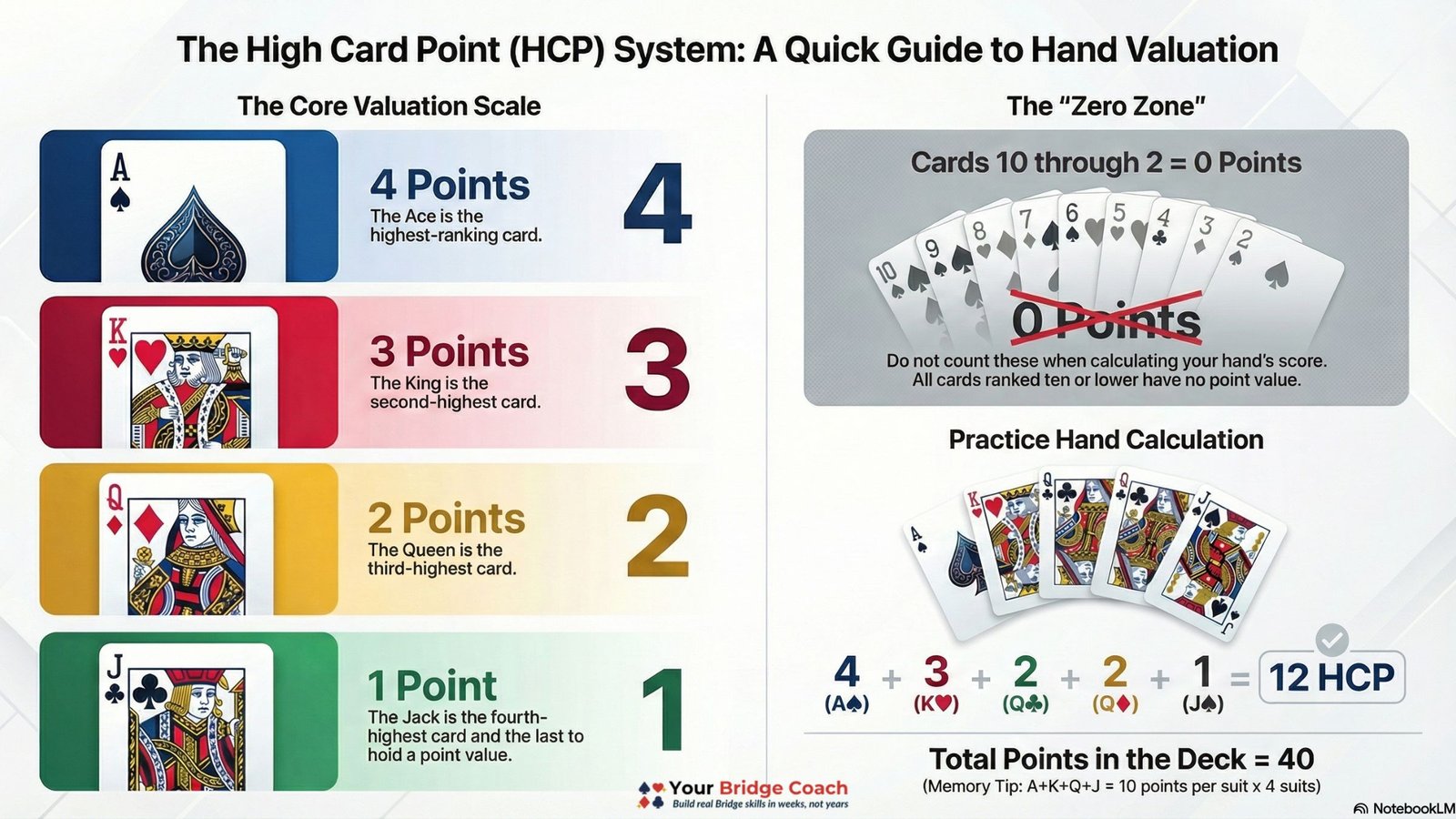
B. Why HCP Matters
Your hand’s HCP total is the first piece of data you must acquire. Knowing this score allows you to:
- Assess Strength: Quickly understand if you have an average hand (around 10 HCP), a poor hand (under 7 HCP), or a strong hand (over 13 HCP).
- Communicate: This score will form the basis of all future partnership communication.
Memory Tip
🧠 “4-3-2-1” The easiest way to remember the scale is counting down the hierarchy: A (4), K (3), Q (2), J (1).
Common Mistakes
⚠️ Miscounting: The only mistake here is simple arithmetic error. Be meticulous. Always double-check that you have counted all the Aces, Kings, Queens, and Jacks in your 13 cards.
⚠️ Ignoring Zeros: Remember that cards 10 through 2 contribute zero points. Don’t waste time counting them—focus solely on the four point-scoring ranks.
Summary
The High Card Point (HCP) system is the fundamental metric in Bridge. It’s a simple 4-3-2-1 count for the Ace, King, Queen, and Jack, respectively. Calculating your HCP total gives you the essential, objective measure of your individual hand’s strength.
Why was this text only?
Because this is for the Visual Learner. You don’t need a 10-minute video to learn “4-3-2-1.” But look below to see what happens when things get a little more complicated…
Bidding Introduction
Now, things get deeper. This lesson tackles the most confusing part of Bridge: The Auction. We use Video (Auditory/Visual) here to visually demonstrate the “Introduction to Bidding.”
⚠️ Before We Begin: The Foundation
Read this first. Bidding is the strategy of Bridge, but playing the cards is the execution. In this course, we assume you have mastered the concepts from our Foundation Course (Course 1). You need to be comfortable with:
- HCP: Counting High Card Points.
- Trick Taking: How to win tricks, finesse, and manage entries.
- Hand Evaluation: Knowing what your hand is actually worth.
Think of it like building a house: Course 1 was the foundation and the brickwork. Core Bidding is the architectural plan. You can draw the most beautiful plans in the world (Bidding), but if you don’t know how to lay the bricks (Play), the house will fall down.
🎯 Learning Objectives
By the end of this lesson, you will be able to:
- Calculate the trick target for any bid using the Level + 6 rule.
- Understand that bidding is a competitive Auction to win the contract.
- Distinguish between Forcing (must reply) and Limited (can pass) bids.
- Recognise the need for agreed conventions and transparency with opponents.
Key Idea
💡 Bidding is a competitive auction. Just like bidding for a painting at an art house, you are competing with the opposition in a process known as an Auction. The pair that bids the highest wins the “Contract”—the right to decide the trump suit and play the hand.
Explanation
The Auction
In a real game, you are not just talking to your partner; you are battling the opponents.
- The Goal: You want to buy the contract because your side has good cards.
- The Risk: If you bid too high, you will fail to make your tricks and pay penalties to the opponents.
- The Opposition: They will try to outbid you or disrupt your communication.
Note: For the first few lessons of this course, we will pretend the opponents are silent so you can master your own signals first.
The Maths: Level + 6 (The “Book” Rule)
In Bridge, the first six tricks are assumed. These are called the “Book.” You only start counting your bid from the seventh trick onwards. Every bid is a specific promise to your partner (and a threat to the opposition).
Example 1: If your partner opens the bidding with 1 Spade ♠️: They are explicitly saying: “I promise that together we can make 7 tricks with Spades as trumps.” (The Calculation: 6 Book + 1 Bid = 7 Tricks).
Example 2: If the final contract is 3 No Trumps: You are promising: “We will make 9 tricks.” (The Calculation: 6 Book + 3 Bid = 9 Tricks).
The Hierarchy (The Ladder)
To win the auction, you must bid higher than the previous person. Bidding must always move upwards.
Clubs ♣️ → Diamonds ♦️ → Hearts ♥️ → Spades ♠️ → No Trumps (NT)
If partner (or an opponent) bids 1 Heart ♥️, you cannot bid 1 Diamond ♦️ (because Diamonds are lower than Hearts). You would have to go up a level to 2 Diamonds ♦️.
The Traffic Lights: Forcing vs. Limited
When communicating with your partner during the auction, we use two types of signals:
- Forcing Bids (Green Light): These are commands. They tell your partner: “I am very strong, or I need more information. You are not allowed to pass.”
- Limited Bids (Red/Amber Light): These are statements of fact. They tell your partner: “I have exactly this amount of strength. I have told you everything.” Your partner is allowed to Pass.
Conventions & Agreements
A “Convention” is simply an agreement between partners that a specific bid has a special meaning.
- Core vs. Advanced: In this course, we concentrate on Core Bids. Even some early bids, such as 1NT, can be artificial because they define a very specific point range rather than just a suit. Advanced players add complex layers, but we will focus on the essential building blocks first.
- Transparency: You must be transparent.
- Online: You fill out a digital Convention Card that opponents can view.
- Face-to-Face: You briefly agree with your partner before playing (e.g., “Do we play Weak or Strong 1NT?”).
Memory Tip
🧠 “Plus Six to Fix”
Whatever number you see in the bid, add six to fix the target.
- See a 1? Promise 7.
- See a 3? Promise 9.
Common Mistakes
⚠️ Watch Out:
- Forgetting the Book: Beginners often think “1 Heart” means they only need to win one trick. Remember, you are promising 7!
- Passing a Forcing Bid: If partner demands a reply (Forcing), silence is fatal. You must keep the bidding alive.
- Secret Codes: Thinking you can have a private meaning with your partner. You must always tell opponents what your artificial bids mean.
Summary
Bidding is an auction where you compete to set a trick target (Level + 6). If you bid 1 Spade, you are explicitly promising to win 7 tricks. This conversation relies on a strict hierarchy and a rhythm of Forcing and Limited signals.
A Final Word: If this all seems complicated—don’t worry. That is the reaction from most students! What you have learned here is just an overview to set the scene. These concepts will be introduced gradually, layer by layer, as we progress through the course.

Foundation Course
- ✓ Complete Foundation Course
- ✓ Designed by a Bridge Mentor
- ✓ Learn in a logical way
- ✓ Beautiful Infographics
- ✓ Interactive Quizzes
- ✓ Video Reinforcers
- ✓ Lifetime Access
Monthly All Access
- ✓ Access to All Bridge Courses
- ✓ Toolkit (Cheatsheets)
- ✓ Defence
- ✓ Bidding
- ✓ Bidding Practice
- ✓ Strategy
- ✓ New Lessons Updated Regularly
- ✓ Price Lock
Yearly All Access
- ✓ Price Lock
Why this is a “No-Brainer”
You could hire a private coach, or you could own the Foundation course for life.
🎓 The Reality Check:
The average UK Bridge coach charges £31.00 per hour.
Don’t pay to learn the basics. We give you all this for free:
- ✓
Lifetime Access: Own the materials forever. - ✓
The “Pause Button”: Missed a concept? Rewind. In a live class, once it’s said, it’s gone. - ✓
Zero Pressure: Learn at your own speed. No rushing to keep up with the fastest student in the room.